Richest Social Media Influencers in the World (2026)
Introduction
In 2019, Forbes put a 21-year-old on its cover and called her the youngest self-made billionaire in history. Fourteen months later, it retracted the claim entirely, accusing her team of submitting fabricated documents. That creator — Kylie Jenner — is still worth well over half a billion dollars today. But the reversal remains one of the best case studies in why “richest influencer” rankings are so hard to get right: private companies don’t publish audited earnings, valuations swing with a single funding round, and the difference between a headline number and real, liquid wealth is often enormous.
This matters because the question “who are the richest social media influencers” gets asked constantly, but most answers online are recycled guesses stacked on top of each other. This guide does something different: every figure here is traced to its source (Forbes, Bloomberg, Celebrity Net Worth, or direct company disclosures), every disputed number is flagged as disputed, and every estimate is labeled as an estimate. That’s the only honest way to cover a topic where the wealthiest people in the room are, almost without exception, privately held business owners rather than publicly traded companies.
Quick Answer
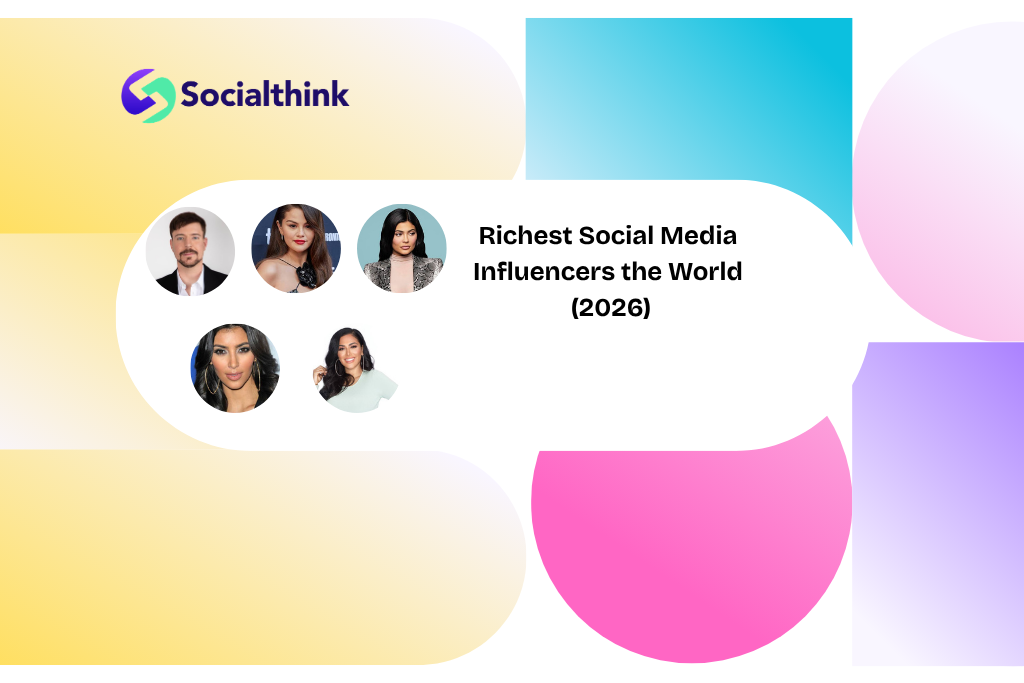
MrBeast (Jimmy Donaldson) is currently the richest social media influencer in the world, with an estimated net worth of $2.6 billion driven mainly by his equity in Beast Industries. Other top-ranked creators include Kim Kardashian (~$1.9B via SKIMS), Selena Gomez (disputed between $700M and $1.3B via Rare Beauty), and Kylie Jenner (~$700M). Nearly all top-tier wealth comes from owned businesses, not ad revenue or sponsorships alone.
1. What “Richest Influencer” Actually Means
Short answer: “Richest influencer” rankings mix two very different things — total net worth (assets minus liabilities, including illiquid company equity) and annual earnings (cash income in a given year) — and conflating them is the single biggest source of confusion in this space.
A creator can have a $2.6 billion net worth on paper while keeping less than $1 million in a personal bank account, because nearly all of that value sits in equity of a private company that hasn’t gone public. That’s not a contradiction — it’s how founder wealth works across every industry, not just the creator economy. Throughout this article, we specify which figure — net worth or annual earnings — we’re citing, and we flag when a headline number is dominated by an illiquid, hard-to-verify private valuation.
We’ve also drawn a boundary around who counts as an “influencer” for this ranking. We prioritized people whose fortune originated substantially through content creation and direct social media audience-building (YouTube, Instagram, TikTok), even where that fortune is now mostly held in a separate company (a beauty brand, a beverage brand, etc.). Athletes and traditional entertainers who happen to have huge follower counts — Cristiano Ronaldo, Lionel Messi — are covered separately in Section 6, since their wealth originates from sport and endorsement contracts rather than platform-native content.
2. How These Net Worth Figures Are Calculated
Short answer: Net worth trackers (Forbes, Bloomberg, Celebrity Net Worth) estimate private company equity using the most recent funding round or acquisition valuation, multiplied by the individual’s disclosed or estimated ownership percentage — a methodology that produces meaningfully different numbers depending on which data each outlet trusts.
This is why you’ll frequently see the same person cited at two different net worth figures within the same month. Selena Gomez is the clearest current example: Bloomberg’s Billionaires Index has listed her at $1.3 billion since September 2024, while Forbes has published estimates closer to $700–800 million. Both are legitimate, methodologically sound estimates — they simply value her stake in Rare Beauty differently, since the company is private and doesn’t publish audited financials.
Rule of thumb for readers: Treat any single net worth figure as the center of a plausible range, not a precise fact. Where two major outlets disagree by more than 30%, we’ve noted both figures rather than picking a winner.
3. Richest Social Media Influencers 2026 (Ranked Table)
Short answer: MrBeast leads by a wide margin at an estimated $2.6 billion, followed by Kim Kardashian (~$1.9B), Selena Gomez (disputed, $700M–$1.3B), Kylie Jenner (~$700M), and Huda Kattan (~$550–610M) — with the common thread being that all built or co-founded a separate product company rather than relying on platform income alone.
| Rank | Influencer | Est. Net Worth | Primary Wealth Source | Confidence Level |
| 1 | MrBeast (Jimmy Donaldson) | $2.6B | Beast Industries equity (majority stake); YouTube, Feastables, streaming deals | Medium — private equity valuation, disputed methodology (Forbes cites lower annual-earnings figure of $85M/yr) |
| 2 | Kim Kardashian | $1.7B–$1.9B | ~33% equity stake in SKIMS ($5B valuation); media deals, beauty | High — Forbes-published, cross-confirmed by Celebrity Net Worth |
| 3 | Selena Gomez | $700M–$1.3B (disputed) | Majority stake in Rare Beauty; acting, music, endorsements | Medium — Bloomberg and Forbes disagree significantly |
| 4 | Kylie Jenner | $670M–$750M | Remaining ~44% stake in Kylie Cosmetics (Coty-owned); real estate, endorsements | High — but explicitly NOT a billionaire despite a retracted 2019 Forbes claim |
| 5 | Huda Kattan | $550M–$610M | 100% ownership of Huda Beauty following 2025 stake buyback | High — Forbes-published |
| 6 | Jeffree Star | ~$200M | Jeffree Star Cosmetics sales | Medium — industry estimate, no recent Forbes update found |
| 7 | Logan Paul | ~$150M | Prime Hydration co-ownership; WWE, YouTube, boxing | Medium-High — Celebrity Net Worth; Forbes cites lower annual income |
| 8 | Jake Paul | $100M–$200M | Boxing purses; Anti Fund venture investments (Ramp, Anduril); “W” brand | Medium — wide range across sources |
| 9 | Anastasia “Like Nastya” Radzinskaya | ~$125M | Family-run children’s content licensing and toy deals | Medium — aggregator-cited, not independently audited |
| 10 | PewDiePie (Felix Kjellberg) | ~$40M | Legacy YouTube ad revenue, Tuber Simulator game royalties, book deal | Medium — wide range ($40M–$100M) depending on source |
| 11 | Emma Chamberlain | ~$12M | Chamberlain Coffee, fashion partnerships, podcast | Medium — smaller scale, less frequently audited by major outlets |
A note on Jake Paul and Logan Paul: Because both brothers earn heavily from event-based boxing purses (which spike net worth in the year they’re paid) and hold private equity in ventures like Prime Hydration and Anti Fund, their relative ranking swaps depending on the source and the month. Treat their order as roughly tied rather than a precise 7th-vs-8th distinction.
4. Profiles: The Top Fortunes in Detail
MrBeast — From Bedroom Videos to a $5 Billion Company
Jimmy Donaldson started uploading videos in 2012 and built a channel now exceeding 640 million subscribers. His net worth is most commonly cited at $2.6 billion (Celebrity Net Worth, Fortune), based on his majority ownership of Beast Industries — the umbrella company behind Feastables chocolate, Lunchly, the Beast Games Amazon Prime series, and (as of February 2026) the fintech app Step. Forbes uses a narrower methodology, estimating his 2024–2025 earnings at $85 million — a very different, and equally legitimate, way of measuring his financial position. Donaldson has been candid that almost none of the $2.6 billion figure is liquid: he’s stated publicly that he keeps under $1 million in personal accounts and had to borrow money around his own wedding, because virtually every dollar generated gets reinvested into bigger content and business expansion.
Why it matters: MrBeast is the clearest proof case that a creator can build enterprise value rivaling mid-cap public companies — but also the clearest illustration of the gap between paper net worth and spendable cash.
Kim Kardashian — Reality TV to SKIMS Equity
Kim Kardashian’s fortune shifted decisively from media appearances to brand ownership with the 2019 launch of SKIMS. Following a $225 million funding round in November 2025 led by Goldman Sachs Alternatives, SKIMS was valued at $5 billion, and Kardashian’s roughly one-third ownership stake now anchors an estimated net worth of $1.7–1.9 billion (Forbes) to close to $2 billion (Celebrity Net Worth). Her earlier venture, KKW Beauty, sold a 20% stake to Coty in 2020 for $200 million — a smaller but structurally similar bet on owned equity over pure endorsement income.
Selena Gomez — The Billionaire Status Bloomberg and Forbes Can’t Agree On
Selena Gomez, the most-followed woman on Instagram at over 420 million followers, built Rare Beauty in 2020 around a mental-health-forward brand identity. Bloomberg added her to its Billionaires Index in September 2024 at $1.3 billion, based on Rare Beauty’s valuation and her majority equity stake. Forbes has pushed back, estimating her closer to $700–800 million, citing more conservative assumptions about the brand’s valuation and reported financial difficulties at her separate mental-health venture, Wondermind. Both figures are defensible; neither is definitively “correct,” which is precisely the point of this article’s methodology section above.
Kylie Jenner — The Billionaire Title That Didn’t Hold Up
Kylie Jenner’s Kylie Cosmetics sold a 51% stake to Coty in November 2019 for $600 million, and Forbes initially used that deal to crown her the youngest self-made billionaire in history. In May 2020, Forbes retracted the claim after finding that Jenner’s team had supplied inflated revenue figures — actual revenue in the year preceding the deal was $177 million, not the roughly $360 million previously reported to the magazine. Today, the most credible estimates from Forbes and Celebrity Net Worth place her net worth at $670–750 million: a genuinely enormous fortune, built from a real $250,000 initial investment and a real $540 million (pre-tax) cash payout from Coty — just short of the ten-figure threshold that made headlines in 2019.
Huda Kattan — The Blog That Became a $1 Billion Brand, Independently Owned
Huda Kattan quit a finance career, trained as a makeup artist in Los Angeles, and launched a beauty blog from Dubai in 2010. Huda Beauty — built initially around false eyelashes sold through Sephora — reached a $1.2 billion valuation when private equity firm TSG Consumer Partners bought a minority stake in 2017. In 2025, Kattan and her sisters bought back TSG’s stake, returning the company to full founder ownership, while separately selling the Kayali fragrance line. Forbes’ most recent published estimate puts her personal net worth at $550–610 million, making her the wealthiest self-made woman to build her fortune primarily on Instagram-native beauty content, and the wealthiest woman entrepreneur based in the Middle East built through social media.
5. The Kylie Jenner Billionaire Retraction: A Case Study in Verification
Short answer: Forbes named Kylie Jenner the youngest self-made billionaire in March 2019, then formally retracted the title in May 2020 after determining her team had provided fabricated tax documents and inflated revenue figures — a widely cited cautionary tale for anyone reporting on influencer wealth.
The timeline, confirmed directly by Forbes’ own reporting:
| Date | Event |
| March 2019 | Forbes names Kylie Jenner the world’s youngest self-made billionaire, based on Kylie Cosmetics’ reported financials |
| November 2019 | Coty Inc. purchases a 51% stake in Kylie Cosmetics for $600 million, valuing the company at $1.2 billion |
| May 2020 | Forbes publishes a retraction, alleging fabricated tax documents and stating actual pre-deal revenue was $177 million, far below the ~$360 million previously reported |
| 2020–2026 | Jenner’s net worth is consistently re-estimated at $670M–$900M across outlets — significant wealth, but below the billionaire threshold |
Why this matters for the whole “richest influencers” genre: It’s the single best-documented example of a major outlet being misled by a creator’s own team, and it’s a permanent reason every figure in this article — and every similar list on the internet — deserves healthy skepticism rather than uncritical repetition.
6. Athlete-Influencers: A Different Category
Short answer: Cristiano Ronaldo and Lionel Messi have the largest social media followings of any individuals on Earth and monetize that reach heavily through endorsements, but the bulk of their net worth — now estimated above $1 billion each — comes from playing contracts, not content creation, which is why we treat them as a distinct category from platform-native influencers.
| Athlete | Est. Net Worth | Platform Reach | Primary Wealth Source |
| Cristiano Ronaldo | $1.2B–$1.4B | 670M+ Instagram followers (most-followed person on the platform) | Al Nassr salary (~$200M+/year, tax-free), lifetime Nike deal (~$1B), CR7 hotel and lifestyle brand |
| Lionel Messi | ~$850M–$1.1B | Among the top 3 most-followed Instagram accounts globally | Inter Miami salary and equity incentives, historic Barcelona/PSG earnings, endorsements |
Both are confirmed billionaires or near-billionaires per Forbes and Bloomberg reporting as of mid-2026 — Ronaldo became the first footballer to cross the threshold in mid-2025, with Messi following via Bloomberg’s index in 2026. Their social followings function primarily as a distribution channel for existing fame rather than the origin of their wealth, which is the key distinction between this category and the platform-native creators ranked in Section 3.
7. Creator Economy Statistics 2026
Short answer: The global creator economy is estimated at roughly $250 billion in 2025 and projected to approach $500 billion by 2027, with Forbes’ top 50 highest-earning creators collectively pulling in an estimated $853 million in the most recent 12-month period — an 18% jump year-over-year.
| Metric | Figure | Source |
| Global creator economy market size (2025) | ~$250 billion | Industry estimates cited across multiple outlets |
| Projected market size by 2027 | ~$500 billion | Industry forecasts |
| Forbes Top 50 creators’ combined earnings (most recent 12 months) | ~$853 million | Forbes, +18% year-over-year |
| Combined followers across Forbes Top 50 | ~3.4 billion | Forbes, +24% year-over-year |
| Projected number of global influencers by 2030 | ~107 million (up from ~67 million currently) | Goldman Sachs |
These figures describe the industry-wide base the individual fortunes above are drawn from — a genuinely large and fast-growing economy, but one where, as in OnlyFans and every other creator platform, the distribution of wealth at the very top is extreme relative to the median creator.
8. Timeline: Milestones in Influencer Wealth
| Year | Milestone |
| 2013 | Huda Kattan launches her beauty blog in Dubai |
| 2015 | Kylie Jenner invests $250,000 of her own earnings into the first Kylie Lip Kit run |
| 2017 | TSG Consumer Partners values Huda Beauty at $1.2 billion in a minority-stake deal |
| 2019 | Forbes names Kylie Jenner the youngest self-made billionaire; Coty buys 51% of Kylie Cosmetics for $600M |
| 2020 | Forbes retracts Jenner’s billionaire title after an investigation into inflated figures |
| 2024 | Bloomberg adds Selena Gomez to its Billionaires Index at $1.3 billion; MrBeast crosses billionaire status via Beast Industries equity |
| 2025 | Cristiano Ronaldo becomes football’s first billionaire following his Al Nassr contract extension; Huda Kattan buys back full ownership of Huda Beauty; SKIMS reaches a $5 billion valuation |
| 2026 | Lionel Messi reportedly crosses billionaire status per Bloomberg; MrBeast’s Beast Industries acquires fintech app Step |
9. Business Model Patterns Among the Richest Influencers
Every fortune profiled above shares a small number of structural traits:
- Ownership over endorsement. Every top-10 name on this list either founded or holds meaningful equity in a company, rather than relying solely on sponsored-post fees. Endorsement income (even at $1–3 million per post for the very top tier) is a supplement to equity wealth, not the primary driver, for anyone above roughly $200 million net worth.
- A single flagship product category. Beauty (Kylie Cosmetics, Rare Beauty, Huda Beauty, Jeffree Star Cosmetics), apparel (SKIMS), and consumer packaged goods (Feastables, Prime Hydration) dominate — categories with relatively low production overhead, direct-to-consumer distribution, and high margins once a large audience already exists.
- Reinvestment discipline. MrBeast is the extreme case, reinvesting the overwhelming majority of revenue into bigger content, but the pattern holds broadly: creators who compound owned-business equity outpace those who simply cash out sponsorship fees.
- Audience size as a distribution moat, not a monetization mechanism on its own. None of the top earners here make their fortune primarily from ad revenue or platform payouts — the audience is valuable specifically because it removes the cost of customer acquisition for a separately owned business.
10. Comparison: Equity Wealth vs. Annual Earnings
Short answer: Net worth (total accumulated value, often illiquid) and annual earnings (cash income in a 12-month window) frequently produce different rankings for the same person — MrBeast tops the net worth list at $2.6B but Forbes’ Top Creators earnings list uses a narrower $85M/year figure for him, which is a completely different kind of number.
| Measure | What It Captures | Example |
| Net worth | Total assets (including illiquid private equity) minus liabilities | MrBeast: $2.6B (Celebrity Net Worth/Fortune) |
| Annual earnings | Cash income received in a specific 12-month period | MrBeast: $85M (Forbes, April 2024–April 2025) |
| Company valuation | The value of a business at its most recent funding round or sale, not the individual’s personal stake | SKIMS: $5B valuation (Kim Kardashian’s estimated stake: ~$1.6–1.7B) |
Marketers and journalists citing “richest influencer” figures should always specify which of these three numbers they mean — they are not interchangeable, and conflating them is the most common error in this kind of reporting.
11. Industry Impact and What Marketers Can Learn
- Equity, not endorsement fees, is now the ceiling-breaker. A decade ago, the biggest creator paydays were sponsored posts. Today, every fortune above roughly $200 million in this list comes from an owned company. Brands hoping to attract top-tier creators as long-term partners increasingly need to offer equity, co-ownership, or licensing structures rather than flat fees.
- Verification failures carry real reputational cost. The Kylie Jenner case shows that even the most rigorous financial media can be misled by a creator’s own team — a reminder that marketers and journalists citing influencer wealth should treat every figure as provisional.
- Follower count and net worth are only loosely correlated. Cristiano Ronaldo has more Instagram followers than anyone alive, but his wealth is overwhelmingly sport-derived. Meanwhile, Huda Kattan’s audience is a fraction of Ronaldo’s, yet she has built one of the largest founder-controlled fortunes of any woman in the creator economy. Follower count predicts reach, not necessarily business outcome.
- Category selection matters enormously. Beauty and apparel dominate this list because they combine low per-unit production complexity with high perceived margin and strong social-native marketing fit — a pattern brand strategists should study when advising creators on which category to enter.
12. Future Trends for 2026 and Beyond
- More creators will pursue owned equity over sponsorship income, following the MrBeast, Kardashian, and Gomez playbook, as the ceiling on ad-revenue and flat sponsorship deals has become clear relative to owned-business upside.
- Valuation disputes will become more, not less, common as more creator-founded private companies reach $1B+ valuations without public listings, keeping outlets like Forbes and Bloomberg in regular disagreement over specific figures.
- Beauty and wellness will likely see new entrants as the playbook (Kylie Cosmetics → Rare Beauty → Huda Beauty → Jeffree Star Cosmetics) continues to be replicated by newer creators with large, trust-based audiences.
- Fintech and financial products are an emerging frontier, illustrated by MrBeast’s Beast Industries acquiring the teen-focused investing app Step in February 2026 — a sign that owned-equity strategies are expanding beyond consumer packaged goods into financial services.
FAQ
MrBeast (Jimmy Donaldson) is most commonly cited as the richest, with an estimated net worth of $2.6 billion, according to Celebrity Net Worth and Fortune. That figure is based primarily on his majority equity stake in Beast Industries, a private company valued at roughly $5 billion — not liquid cash.
No, not currently, despite widespread belief that she is. Forbes named her the youngest self-made billionaire in 2019, then retracted that title in May 2020 after finding her team had inflated revenue figures. Current credible estimates place her net worth at $670–750 million.
Because most top-tier influencer wealth is held in private company equity, which doesn’t have a public stock price. Outlets like Forbes, Bloomberg, and Celebrity Net Worth make different assumptions about company valuation and ownership percentage, which is why Selena Gomez, for example, is cited anywhere from $700 million to $1.3 billion depending on the source.
It’s disputed. Bloomberg’s Billionaires Index added her at $1.3 billion in September 2024, based on her majority stake in Rare Beauty. Forbes has published lower estimates around $700–800 million. Both figures come from credible outlets using different valuation methodologies for the same private company.
Very differently. Forbes estimated his 2024–2025 earnings (cash income) at $85 million, while his overall net worth (largely illiquid company equity) is estimated at $2.6 billion. Donaldson himself has said he keeps less than $1 million in personal accounts, since almost all revenue is reinvested into the business.
No, not at the very top. Every influencer in the top 10 of this ranking derives the overwhelming majority of their net worth from equity in an owned company (a beauty brand, an apparel brand, a consumer product business) rather than platform ad revenue or sponsored-post fees, which typically supplement rather than drive top-tier wealth.
They have the largest social media followings of any individuals, but their wealth is overwhelmingly derived from playing contracts and traditional endorsement deals, not content creation. Most creator-economy analysts treat them as a separate “athlete-influencer” category rather than platform-native creators.
Industry estimates place the global creator economy at roughly $250 billion in 2025, with projections suggesting it could approach $500 billion by 2027. These figures come from industry analyst reports rather than a single audited source, so treat them as informed estimates.
That a headline net worth figure represents spendable cash. In reality, for nearly every top-10 name on this list, the vast majority of reported net worth is illiquid private company equity that would require a sale, IPO, or funding round to convert into cash — and doing so could itself change the valuation.
Conclusion
The richest social media influencers in 2026 share one clear pattern: none of them got there from ad revenue or brand deals alone. MrBeast, Kim Kardashian, Selena Gomez, Kylie Jenner, and Huda Kattan all converted platform-native audiences into owned equity in real, separately valued businesses — and that equity, not the sponsored posts that made them famous, is what actually shows up in a net worth estimate.
Actionable takeaways:
- Treat every net worth figure in this space as an estimate with a plausible range, not a fact — and note whether a source is citing net worth, annual earnings, or company valuation, since these are frequently confused.
- If you’re a creator or marketer studying this list for a playbook, the throughline is “own a product,” not “post more content.”
- Remember the Kylie Jenner case whenever a headline number seems too clean: even Forbes has been misled by a creator’s own reporting, and it can happen again.
- Follower count is a distribution advantage, not a wealth guarantee — plenty of massive accounts have never converted reach into comparable business value.
For readers who want to go deeper, we recommend exploring how individual platforms like YouTube and TikTok pay creators directly, and how beauty and wellness brands specifically have become the dominant vehicle for turning influence into long-term wealth.