B2B vs B2C Social Media Strategy: What’s the Difference?
B2B vs B2C social media strategy is not just two different content styles – they are two completely different mindsets. Who you are talking to changes what you say, where you say it, and how you say it. Get this wrong and even a big budget will not save your campaign.
A marketing manager at a Delhi-based logistics firm kept asking why their Facebook ads were not generating business inquiries. They had good creatives, decent spend, and regular posting. The problem was simple – they were running a B2C playbook for a B2B product. Once they understood the gap between B2B vs B2C social media strategy, they moved to LinkedIn and rewrote their content entirely. Within six weeks, three genuine leads came through.
What Is the Core Difference in B2B vs B2C Social Media Strategy?
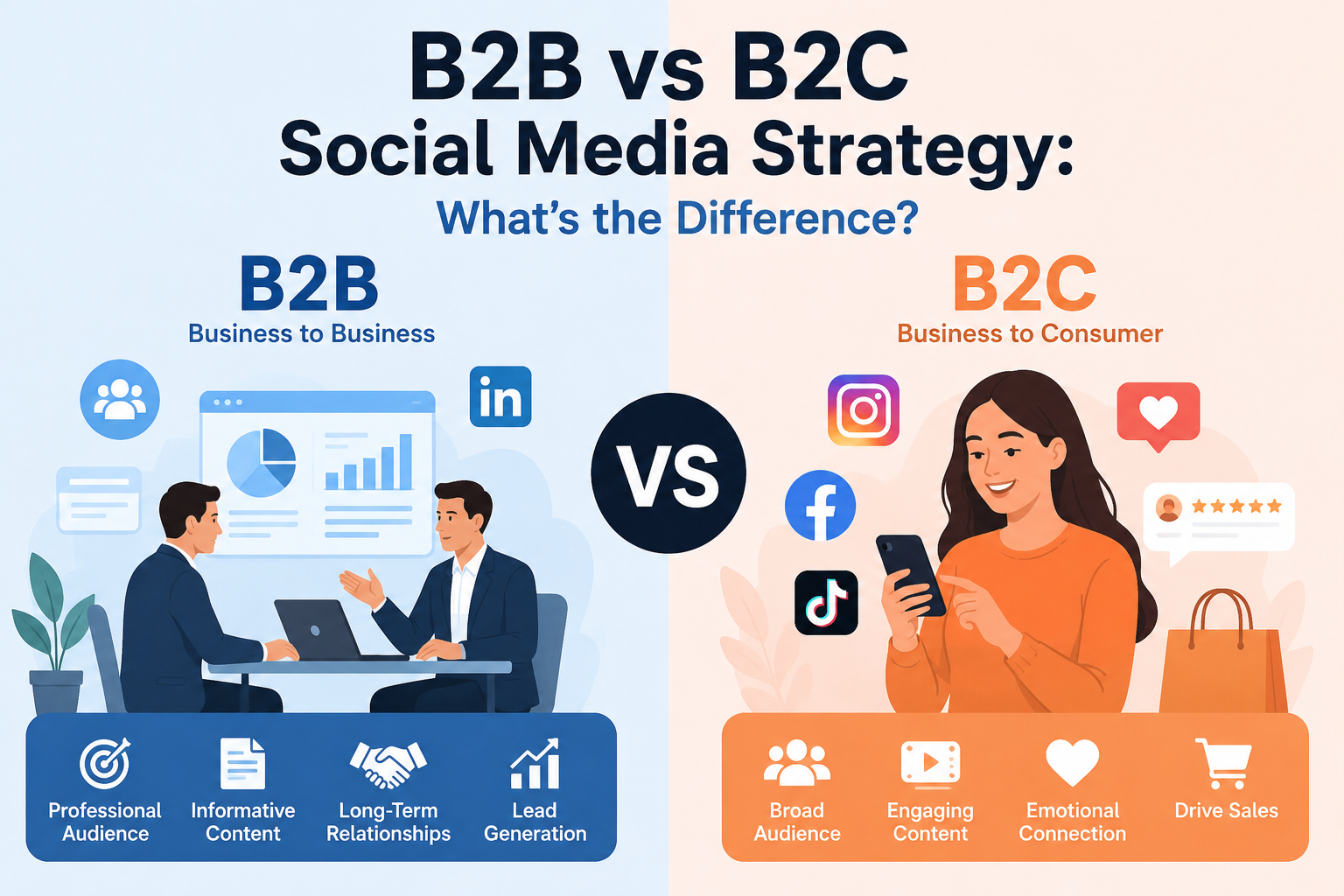
B2B vs B2C social media strategy comes down to one thing – who makes the buying decision. In B2B, it is rarely one person. In B2C, it almost always is.
B2B buyers do not scroll through a feed and make a snap decision. They compare options, get approvals, sit through demos, and then maybe say yes – three months later.
B2C buyers see something they like, check the price, and hit buy. The whole journey can happen during a lunch break. That gap in decision-making shapes every single part of how you show up on social media.
Which Platforms Work Best for Each B2B vs B2C Social Media Strategy?
The right platform is where the B2B vs B2C social media strategy starts to look like two entirely separate jobs. B2B belongs on LinkedIn, YouTube, and Twitter/X. B2C belongs on Instagram, TikTok, and Facebook.
Here is a clear platform breakdown:
| Platform | Best For | Content Type |
| B2B | Thought leadership, case studies, job posts | |
| Twitter/X | B2B | Industry news, quick insights, networking |
| YouTube | Both | Product demos, tutorials, brand stories |
| B2C | Visual storytelling, reels, influencer content | |
| TikTok | B2C | Short-form video, trends, and entertainment |
| B2C | Community building, ads, events |
A B2B brand grinding away on Instagram reels is burning time on an audience that will not convert. A B2C brand trying to go viral on LinkedIn is fishing in the wrong pond. Platform fit is not optional – it is the foundation.
How Does Content Style Differ in B2B vs B2C Social Media Strategy?
Content style is where the B2B vs B2C social media strategy feels most different day to day. B2B content has to earn trust before it asks for anything. B2C content can go straight for the feeling.
- B2B posts lead with data, outcomes, and industry insight
- B2C posts lead with emotion, aesthetics, and personality
- B2B content takes the form of case studies, whitepapers, carousels, and webinars
- B2C content lives in reels, stories, giveaways, and influencer collabs
A good example – brands highlighted on socialthink.io show this clearly. A B2B SaaS brand posts “How a 200-person team reduced their reporting time by 40%.” A D2C candle brand posts a cosy evening reel with a limited-time discount code. Neither post is wrong. Each one is exactly right for its audience.
What Are the Goals Behind Each B2B vs B2C Social Media Strategy?
The goals sitting behind B2B vs B2C social media strategy are not just different – they run on different clocks. B2B wants pipeline, credibility, and long-term relationships. B2C wants reach, sales, and loyalty – and wants them faster.
B2B social media goals typically include:
- Pulling qualified leads into the sales funnel
- Building the brand’s reputation as a credible industry voice
- Staying present through a buyer’s long research and approval process
- Supporting high-value account targeting through relevant content
B2C social media goals typically include:
- Getting the brand in front of as many potential buyers as possible
- Pushing people to product pages, offers, and checkout
- Creating a community that keeps coming back
- Generating user content, reviews, and word-of-mouth
A B2B team celebrates when a CFO comments on their LinkedIn post asking for a demo. A B2C team celebrates when a reel hits a hundred thousand views before noon. Same platform, completely different finish lines.
How Does the Buying Cycle Affect B2B vs B2C Social Media Strategy?
No other factor splits B2B vs B2C social media strategy more cleanly than the buying cycle. B2B deals stretch over weeks, involve multiple people, and require consistent nurturing. B2C deals can close in the same session that a buyer first sees the ad.
Think about a Mumbai-based company selling HR tech to mid-sized firms. Their social media has to speak to an HR head, a finance decision-maker, and sometimes the CEO – each at a different stage of interest. One post will not do it. The strategy has to work across a full journey.
Now think about a skincare brand targeting working women between 25 and 35. One strong Instagram ad with the right copy and a discount code can move product the same evening. No approval chain, no follow-up calls, no demo required.
How Should You Measure Success in B2B vs B2C Social Media Strategy?
Measuring results in B2B vs B2C social media strategy means tracking completely different numbers. B2B cares about lead quality, pipeline contribution, and whether the right people are engaging. B2C cares about reach, conversions, and acquisition cost. Using the right social media tools makes it easier to monitor these metrics and improve campaign performance.
| Metric | B2B Priority | B2C Priority |
| Lead Quality | High | Low |
| Engagement Rate | Medium | High |
| Cost Per Lead | High | Medium |
| Follower Growth | Low | High |
| Sales Conversions | Long-term | Immediate |
| Brand Sentiment | High | High |
A B2B brand obsessing over follower count is measuring the wrong thing entirely. On the other hand, a B2C brand spending hours analysing lead quality from organic posts is wasting time it could spend scaling what is already working. Choosing the right social media service can help businesses focus on the metrics that actually drive growth and results.
FAQ
Q1. Can a company run both B2B and B2C social media strategy together?
Yes, but they need separate content plans, separate messaging, and often separate accounts. Mixing both in one feed confuses the audience and dilutes the brand.
Q2. Which platform works best for B2B vs B2C social media strategy on the B2B side?
LinkedIn is the strongest platform for B2B. YouTube and Twitter/X support it well for thought leadership and community building among professionals.
Q3. Can Instagram work for B2B brands?
It works for culture and hiring content, but it rarely drives actual B2B leads. For lead generation, LinkedIn is a much better fit than Instagram.
Q4. How frequently should each type of brand post?
B2B brands get good results with 3 to 4 high-quality posts per week. B2C brands usually need daily posting to stay competitive in fast-moving feeds.
Q5. Does B2B vs B2C social media strategy change how much you spend on ads?
Yes. B2B ad audiences are smaller and more targeted, so cost-per-click is higher. B2C ads go wider at lower individual costs but need volume to drive revenue.